

The unprecedented costs pressures on independent schools from 2024 to 2026 have led many schools to rethink their pricing strategies. To be honest, most schools didn’t have one, or if they did, it was Cost+ and/or finger-in-the-air at the annual fee review meeting.
Parents have also been thinking about affordability, especially since January 1 2025, when VAT was applied to fees. They are aware that prior to 2025 school fees rose at cosy above-inflation rates for as many years as they can remember. I get more questions about value and ‘what am I getting for my money’ from current fee payers than any other topic.
As a background to any conversation we may have, parent or school, I’ve written this article to generalise why fees vary and how parents might trade off fee differences for elements of school provision, in an ideal world. The article draws on data from a 12-year study of independent school fees.
Prep schools have varied pricing strategies
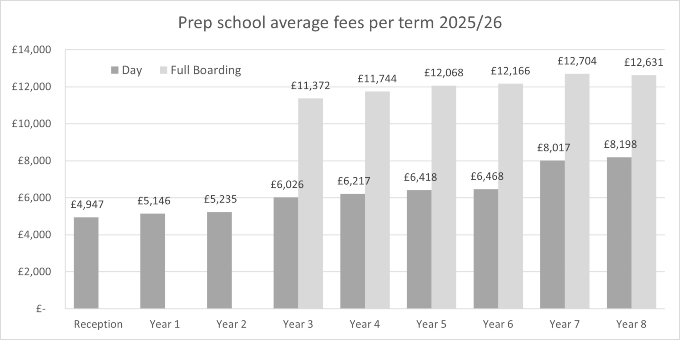
In 2025/26 it costs a total of £121k to send your child to the average UK prep school from Reception to Year 6. And that’s just tuition fees. Extend to Year 8 and the cost rises to £169k. If you take a full boarding option from Year 3 to Year 6 the cost rises to £189k, and to Year 8; £264k. These fees include VAT.
Prep schools adopt a variety of fee strategies. To start with, what they include and what they don’t include. Lunches and residential trips are the large ticket examples for day fees. Include them, and the school is signalling a ‘no more extras or nasty surprises’ message. Exclude them, and the school is looking for a favourable price comparison, a ‘we are cheaper’ message.
More important is the increase in tuition fees as the pupil progresses through the school, as illustrated in the graphic (lunches and trips stripped out). Year to year, excluding inflation but including VAT, prep school fees increase by about £100-200 per term, with a more significant jump of £800 per term from Year 2 to Year 3, and £1,500 per term from Year 6 to 7.
Why? Is it that teaching older children costs more than teaching younger children? Or that day trips, teaching materials and shared facilities are more expensive for older children? Possibly, but not by £800-£1,500 per term. I think the answer lies in habit; the way things have always been done. That’s why, as well as these annually stepped fee policies, there are just as many schools that have a flat fee for Years 1 and 2, for Years 3 to 6, and even throughout the prep years.
Prep schools absorbed a significant amount of the 2025 VAT increase
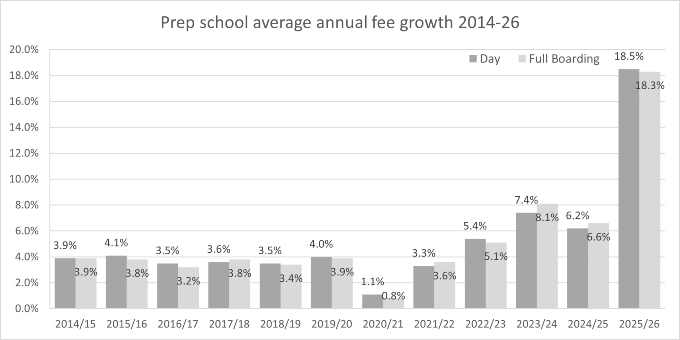
In the good old days, when inflation and interest rates were low, prep school fees rose at an average of 3-4% per year. COVID depressed fee increases in 2020/21. In that year 67% of schools either didn’t raise fees or they reduced them. But since then, fee increases gathered pace to 7.4% for day fees in 2023/24 and 6.2% in 2024/25.
In January 2025 schools had to charge VAT. The question governors faced was ‘how many pupils will leave if we pass on the full 20% to parents’. Only 14% of preps passed on the full 20%, those who were comfortable that parents could pay. The remaining 86% of schools absorbed a portion of the new charge, for the remaining two terms of the academic year, funding it through a mix of reserves and cost cutting. On average, they increased fees by 12.8%, picking up the 7.2% themselves. A heroic 19 schools absorbed the full 20%, passing nothing on to parents.
This isn’t shown on the graphic for 2024/25, but the increase including VAT is picked up in the 2025/26 fees for the sake of comparison. But what the average fee increase for the 2025/26 does show is that schools continue to absorb 1.5% of VAT. Which means that the average school has cut its own costs by 1.5% in real terms.
How prep school fees vary by location, age and gender
So now let’s look at some elements of educational provision and how they seem to affect average fees. Geography is an obvious, and often reported one. It’s no surprise that prep schools in London have higher fees than the national average. 32% higher, in fact. And it is well known that fees are lower in the north and west of the country, compared to the national average. But fees aren’t uniformly higher or lower in these regions. For example, around Maidenhead fees are 12% higher than the national average, but 2% below in Reading. Both would count as Home Counties preps where the average is 3% above. Competition as well as local demographics are factors.

Parents probably suspect, but don’t know, that prep schools that teach to Year 8 have higher fees (to Year 6) than those preps that teach to Year 6. The same goes for day fees at schools that have boarders.
Single sex education can come at a cost. Fee levels at boys-only and girls-only prep schools aggregate at 14% more than the national average.
How prep school fees vary by ownership, size and class size

Looking for economies of scale and back-office efficiencies, it would appear that junior departments of all-through schools charge less than standalone prep schools. It might be tactical pricing, of course, but schools that are part of larger for-profit or charitable school groups also charge lower fees, on average.
But economy of scale arguments aren’t reflected in lower fees at larger schools, or those with larger class sizes. Counter-intuitively, the data suggests that parents might pay less at prep schools with less than 140 pupils (Rec-Year 6). The same goes for those with class sizes of less than 15 pupils.
How prep school fees vary by facilities

Prep schools with a wide range of facilities charge more. And preps with fewer facilities charge significantly less. We can almost indicate fee pricing increments by each individual facility, with due caution for double counting. For illustrative purposes, prep schools with swimming pools charge 14% more than those that don’t. But a sports hall (as opposed to a multi-purpose hall) only commands a 4% premium.
Attractive buildings and grounds also attract a 6% fee premium, which is less than we might have expected.
Facilities cost money to build. What this analysis doesn’t show is the step change in fees before and after the build. It can be significant.
How prep school fees vary by curriculum and results

Championing a broad curriculum allows a prep school to charge higher fees, it would seem. Parents are prepared to pay the 325 schools with the broadest academic programme, the 370 with the widest sports provision and the 301 with the widest arts provision a 9%-15% fee premium. However, a fully developed outdoor learning programme attracts only a 2% premium.
Securing a track record for academic results is important for setting fee levels higher than the national average. It isn’t surprising that parents pay a premium for proven results. And the oft-quoted prep school difference being subject specialist teaching seems to be reflected in an 11% fee premium for the 415 prep schools that do it most.
Final thoughts
We have to be careful how literally we use this modular approach, for two reasons. The first, as previously mentioned, is that there is potential for double counting. For example, a significant number of prep schools with a swimming pool may also have a sports hall.
Secondly, it assumes that you can switch from a high fee prep to a lower fee alternative, which may not be feasible.
But switching may be an option for some. And for prep schools, being a more focussed alternative may prove to be an attractive strategy as the fee-increase fallout gains momentum.